

What Is the Zen Story of the Empty Cup (Nan-in), and How Does It Support Spiritual Awakening in 2026?
Introduction
What is the Zen story of the empty cup (Nan-in), and how does it support spiritual awakening? At first glance, it seems like a simple teaching about a teacup overflowing. But beneath its simplicity lies one of the most powerful lessons in Zen philosophy—how our minds, filled with assumptions, block true understanding.
The story of Nan-in is widely shared in Zen Buddhism as a metaphor for openness, humility, and the readiness to learn. In a modern world overloaded with information, opinions, and distractions, this story offers a deeply relevant path toward clarity and awakening.
In this article, you’ll explore the full story, its deeper meaning, and how it directly supports spiritual awakening in everyday life.
What Is the Zen Story of the Empty Cup (Nan-in), and How Does It Support Spiritual Awakening?
The Zen story of the empty cup revolves around a university professor who visits Nan-in, a respected Zen master, to learn about Zen.
As they sit together, Nan-in begins pouring tea into the professor’s cup. He continues pouring even after the cup is full—until it overflows onto the table.
Surprised, the professor exclaims, “Stop! The cup is already full. No more will go in.”
Nan-in calmly replies, “Like this cup, you are full of your own opinions and ideas. How can I show you Zen unless you first empty your cup?”
This simple exchange reveals a profound truth: learning and awakening require an open, uncluttered mind.
The Full Story of the Zen Empty Cup (Nan-in)

The Curious Professor
A learned professor, confident in his academic knowledge, sought to understand Zen. He approached Nan-in not as a beginner, but as someone already filled with theories and conclusions.
This reflects a common modern mindset—we often seek knowledge while believing we already know enough.
The Tea Ritual
Nan-in invited the professor for tea, a traditional and symbolic act in Zen culture. As he poured tea into the professor’s cup, everything appeared normal—until the cup became full.
Yet Nan-in continued pouring.
The tea spilt over, creating confusion and discomfort.
The Overflowing Cup
The professor, unable to ignore the obvious, protested. The situation had become illogical—no more tea could fit.
This moment represents a turning point. It exposes a deeper issue: the inability to receive when already full.
The Moment of Insight
Nan-in’s response was direct and transformative. By comparing the professor’s mind to the overflowing cup, he revealed the core problem:
A mind filled with assumptions, ego, and preconceived ideas cannot absorb new wisdom.
This realisation forms the foundation of spiritual awakening.
Key Teachings from the Zen Story of the Empty Cup (Nan-in)
The Importance of Mental Emptiness
In Zen philosophy, “emptiness” does not mean nothingness. Instead, it refers to a state of openness and receptivity.
An empty mind is not blank—it is ready.
When we let go of rigid beliefs, we create space for deeper understanding.
Letting Go of Ego
The professor’s knowledge became his limitation. His identity as an expert prevented him from being a student.
Ego often manifests as:
- “I already know this.”
- “My way is correct.”
- “I don’t need to change.”
Spiritual awakening begins when we release this ego-driven mindset.
Beginner’s Mind (Shoshin)

Zen emphasises the concept of beginner’s mind—approaching life with curiosity, openness, and lack of preconceptions.
Even experts are encouraged to think like beginners.
This mindset allows continuous growth and deeper insight.
Awareness Over Accumulation
Modern culture encourages constant accumulation—information, achievements, opinions.
But Zen teaches the opposite: true wisdom comes from awareness, not accumulation.
The empty cup reminds us that clarity often arises when we remove, not add.
How the Zen Story of the Empty Cup (Nan-in) Supports Spiritual Awakening
Awakening Through Unlearning
Spiritual awakening is not just about learning new concepts—it’s about unlearning false assumptions.
The professor didn’t need more knowledge. He needed less mental clutter.
Letting go creates space for truth to emerge.
Cultivating Mindfulness
An empty mind is a mindful mind—present, aware, and undistracted.
When you stop overthinking and judging, you begin to experience life directly.
This presence is a key component of awakening.
Breaking Mental Conditioning
We are conditioned by culture, education, and personal experiences.
These mental patterns shape how we see the world—but they can also limit us.
The empty cup teaches us to question these patterns and see reality more clearly.
Opening to Transformation
Transformation requires flexibility.
A rigid mind resists change, while an open mind embraces it.
By “emptying your cup”, you become adaptable, receptive, and capable of growth.
Practical Lessons You Can Apply Today
Practice Letting Go of Assumptions
Notice when you quickly judge or assume something.
Pause and ask:
- “Am I seeing this clearly?”
- “What if I’m wrong?”
This simple shift creates mental space.
Listen Without Interrupting
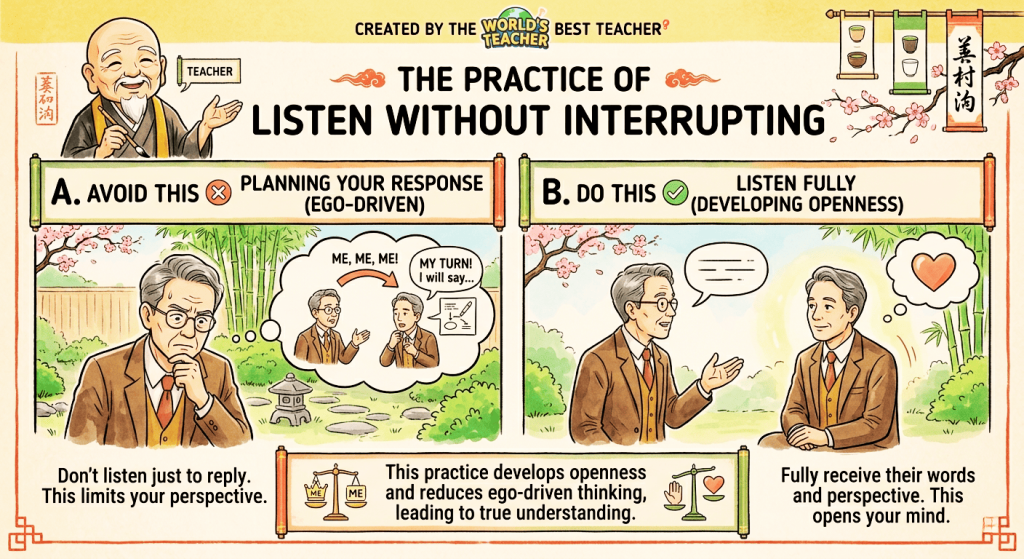
When talking to others, avoid planning your response while they speak.
Instead, listen fully.
This practice develops openness and reduces ego-driven thinking.
Simplify Your Mental Input
Too much information creates a “full cup”.
Reduce unnecessary content consumption—news, social media, noise.
Create space for clarity.
Try Mindfulness Meditation
Spend 5–10 minutes daily observing your thoughts without reacting.
This helps you recognise mental clutter and gradually release it.
Embrace Not Knowing
Uncertainty is uncomfortable—but it’s also powerful.
Admitting “I don’t know” is the beginning of wisdom.
Why This Zen Story Still Matters Today
In today’s digital age, people are constantly overwhelmed with information. Everyone has opinions, and knowledge is often mistaken for wisdom.
The problem? Most minds are already full.
The Zen story of the empty cup offers a solution that is both simple and profound: before seeking more, make space.
For modern audiences—especially those interested in personal growth, mindfulness, and self-improvement—this teaching is incredibly relevant.
It reminds us that spiritual awakening is not about becoming more but about removing what blocks clarity.
Conclusion & Call-to-Action
So, what is the Zen story of the empty cup (Nan-in), and how does it support spiritual awakening?
It is a timeless lesson about openness, humility, and the power of an uncluttered mind. Through a simple act of pouring tea, Nan-in revealed a truth that applies to all of us: we cannot receive new wisdom if we are already full.
Spiritual awakening begins when we let go—of ego, assumptions, and mental noise.
Call to Action:
Take a moment today to reflect:
What is filling your cup right now?
Start small—let go of one assumption, one judgement, or one unnecessary thought. Create space, and notice what enters.