
What Is the Story of Kisagotami and the Mustard Seed, and How Does It Support Spiritual Awakening in 2026?
Introduction
What is the story of Kisagotami and the mustard seed, and how does it support spiritual awakening? This timeless Buddhist teaching offers one of the most powerful reflections on grief, acceptance, and the nature of life itself.
The story of Kisagotami is not just a tale from ancient times—it is a deeply human experience that resonates across cultures and generations. It speaks to anyone who has ever faced loss, confusion, or emotional pain. Through her journey, guided by Gautama Buddha, we uncover profound truths about suffering, impermanence, and the path to inner peace.
In this article, you’ll explore the full story, its deeper meaning, and how it directly supports spiritual awakening in everyday life.
What Is the Story of Kisagotami and the Mustard Seed, and How Does It Support Spiritual Awakening?
At its core, the story tells of a grieving mother who loses her only child and desperately seeks a way to bring him back to life. In her sorrow, she turns to the Buddha, hoping for a miracle.
Instead of offering a direct solution, the Buddha gives her a simple yet transformative task: bring a mustard seed from a household where no one has ever died.
What follows is not just a physical journey but a deeply spiritual one. Through her search, Kisagotami discovers a universal truth: death and loss are part of every human life. This realisation becomes the foundation of her spiritual awakening.
The Full Story of Kisagotami and the Mustard Seed

Kisagotami’s Tragic Loss
Kisagotami was a young woman who deeply loved her child. When her only son suddenly died, her world collapsed. Overwhelmed by grief, she refused to accept reality. She carried the lifeless body from place to place, begging for medicine that could bring him back.
Her pain reflects a universal human reaction—denial in the face of unbearable loss.
Seeking Help from the Buddha
Eventually, someone directed her to the Buddha, known for his wisdom and compassion. She approached him with desperation, pleading for a cure for her child.
Understanding her emotional state, the Buddha did not dismiss her request. Instead, he offered a task:
“Bring me a mustard seed from a house where no one has experienced death.”
At first, Kisagotami felt hopeful. The task seemed simple.
The Search for a House Without Death
She went from house to house, asking for mustard seeds. Every household was willing to help—but when she asked if death had ever touched their family, the answer was always the same.
“Yes, we have lost someone.”
As she continued her search, a powerful realisation began to emerge. No family was untouched by death. Loss was not unique to her—it was shared by all.
This moment marks the turning point in her journey.
The Moment of Realization
Gradually, Kisagotami’s grief transformed into understanding. She recognised that death is not a personal injustice but a universal reality.
She returned to the Buddha empty-handed—but no longer desperate. Instead, she carried a new awareness. Through this insight, she let go of her attachment and began her path toward spiritual awakening.
Key Teachings from the Story of Kisagotami and the Mustard Seed
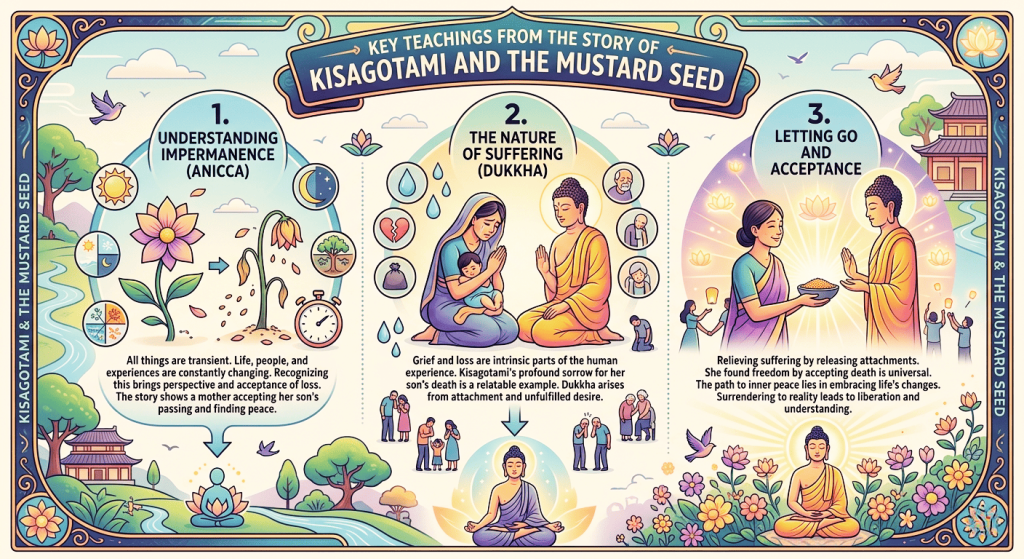
Understanding Impermanence (Anicca)
One of the central teachings illustrated in this story is impermanence. Everything in life—people, emotions, experiences—changes and eventually passes away.
Kisagotami’s journey teaches that resisting this truth leads to suffering, while accepting it opens the door to peace.
The Nature of Suffering (Dukkha)
Suffering arises from attachment—the desire to hold onto what cannot last. Kisagotami’s pain was not only from loss but also from her refusal to accept it.
This aligns with a fundamental Buddhist insight: suffering is a natural part of life, but understanding its cause allows us to move beyond it.
Letting Go and Acceptance
Acceptance does not mean indifference. It means seeing reality clearly and responding with wisdom rather than resistance.
When Kisagotami accepted the truth of death, her suffering began to dissolve. Letting go became an act of liberation, not loss.
How the Story of Kisagotami and the Mustard Seed Supports Spiritual Awakening
Awakening Through Real-Life Experience
Spiritual awakening is often misunderstood as something mystical or distant. In reality, it begins with direct experience.
Kisagotami did not awaken through theory—she awakened through her own journey of grief and discovery. This shows that everyday life itself is the path.
Developing Compassion and Empathy
As Kisagotami visited each household, she heard stories of loss from others. This expanded her perspective and softened her heart.
Understanding that everyone suffers fosters compassion—a key element of spiritual growth.
Moving Beyond Attachment
Attachment creates fear—fear of loss, change, and uncertainty. By recognising impermanence, Kisagotami learned to release her grip on what she could not control.
This shift is essential for spiritual freedom.
Applying Mindfulness in Daily Life
The story encourages mindfulness—being present with reality as it is.
Instead of resisting pain, we can observe it, understand it, and allow it to pass. This practice transforms suffering into wisdom.
Practical Lessons You Can Apply Today

Accepting Life’s Impermanence
Change is not the exception—it is the rule. Accepting this reduces anxiety and helps you adapt with resilience.
Start by noticing small changes in daily life and embracing them without resistance.
Coping with Loss in a Healthy Way
Grief is natural, but holding onto denial prolongs suffering. Allow yourself to feel emotions fully, but also seek understanding.
Talking to others, journaling, or practising meditation can help process loss.
Practicing Gratitude and Presence
When you accept that everything is temporary, you begin to value the present moment more deeply.
Simple practices like mindful breathing or gratitude journaling can strengthen this awareness.
Why This Ancient Story Still Matters Today
In today’s fast-paced world, many people struggle with stress, anxiety, and emotional disconnection. Despite technological progress, the fundamental challenges of human life remain the same.
The story of Kisagotami offers a timeless solution: understanding reality as it is.
For modern readers—especially those seeking meaning, healing, or personal growth—this teaching provides clarity and direction. It reminds us that spiritual awakening is not about escaping life but about seeing it clearly.
Conclusion
So, what is the story of Kisagotami and the mustard seed, and how does it support spiritual awakening?
It is a journey from grief to wisdom, from attachment to acceptance, and from suffering to peace. Through her experience, Kisagotami discovered a universal truth: loss is part of life, but understanding it leads to freedom.
Her story teaches us that awakening is not found in avoiding pain—but in transforming it.
Call to Action:
Take a moment today to reflect on what you are holding onto. Can you gently let it go? Start with awareness, practise mindfulness, and explore more teachings that guide you toward inner peace.