What Is the Story of The Zen Archer, and How Does It Support Spiritual Awakening in 2026?
Introduction
What is the story of The Zen Archer, and how does it support spiritual awakening? At first glance, it may seem like a simple tale about learning archery. But beneath the surface, it reveals a profound truth about the human mind, ego, and the path to inner peace.
In a world driven by goals, achievements, and constant pressure—especially in fast-paced environments like the United States—this ancient Zen teaching offers a radically different perspective. It suggests that true mastery, whether in life or spirituality, does not come from force or control. Instead, it arises from presence, awareness, and letting go.
The story gained widespread attention through the book Zen in the Art of Archery by Eugen Herrigel, which explores how archery becomes a gateway to understanding Zen principles. Let’s break down this story step by step—and more importantly, explore how it can transform your journey toward spiritual awakening.
What Is the Story of The Zen Archer? (Overview)
The story of The Zen Archer follows a student who travels to Japan to learn the art of archery under a Zen master. Like most beginners, he believes success depends on technique, precision, and hitting the target.
However, the master teaches something entirely unexpected.
Instead of focusing on aiming or shooting, the student is asked to practise drawing the bow—again and again—without worrying about the result. Months pass with no visible progress. Frustration builds.
Eventually, the student realises a deeper truth: the goal is not to hit the target. The goal is to dissolve the self that wants to hit the target.
In Zen philosophy, true action happens when there is no “doer”—only pure awareness.
The Story of The Zen Archer Explained (Step-by-Step)
The Student’s Desire for Mastery
At the beginning, the student represents most of us.
He wants quick results. He wants to succeed. He believes mastery comes from effort and control.
This mindset mirrors modern life—where productivity, deadlines, and measurable outcomes dominate our thinking. But in spiritual awakening, this approach becomes a limitation.
Why? Because the more you try to control, the more tension you create.
The Master’s Unexpected Teaching Method
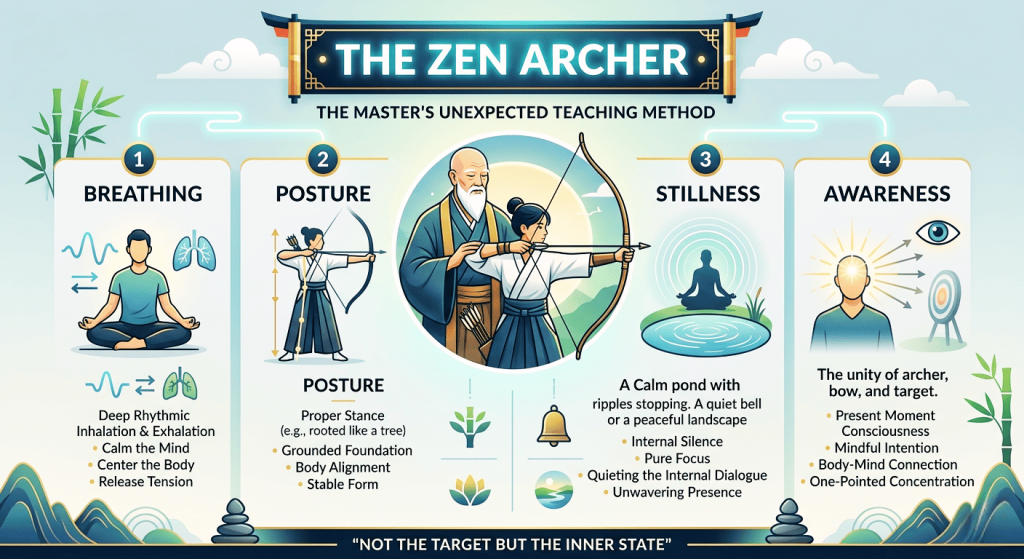
The Zen master introduces a completely different approach.
Instead of teaching how to hit the target, he emphasises the following:
- Breathing
- Posture
- Stillness
- Awareness
The student is confused. Why ignore the goal?
Because in Zen, focusing on the outcome creates attachment—and attachment leads to suffering.
The master’s teaching aligns with core principles of Zen Buddhism, where the process matters more than the result.
The Turning Point: Letting Go of Control
After repeated failures, the student reaches a breaking point.
He realises that his desire to succeed is actually preventing success.
This is the turning point.
He begins to let go:
- Let go of expectations
- Let go of fear
- Let go of ego
And something shifts.
Instead of forcing the shot, he allows it to happen.
The Final Insight: Becoming One With the Act
In the final stage, the student experiences a moment of deep awareness.
There is no longer:
- Archer
- Bow
- Target
There is only action.
The arrow releases itself.
This is the essence of Zen—and a powerful metaphor for spiritual awakening.
Core Lessons from The Zen Archer for Spiritual Awakening
Lesson 1 – Detachment Leads to Clarity
Attachment to outcomes creates anxiety.
When you constantly worry about results, your mind becomes restless. But when you detach, clarity emerges.
Spiritual awakening begins when you stop clinging and start observing.
Lesson 2 – Presence Is More Powerful Than Effort
Modern culture glorifies hustle. Zen teaches the opposite.
Presence—not effort—is the real source of power.
When you are fully present:
- Your actions become precise
- Your mind becomes calm
- Your awareness deepens
This is often described as a state of “flow”.
Lesson 3 – The Ego Is the Real Obstacle
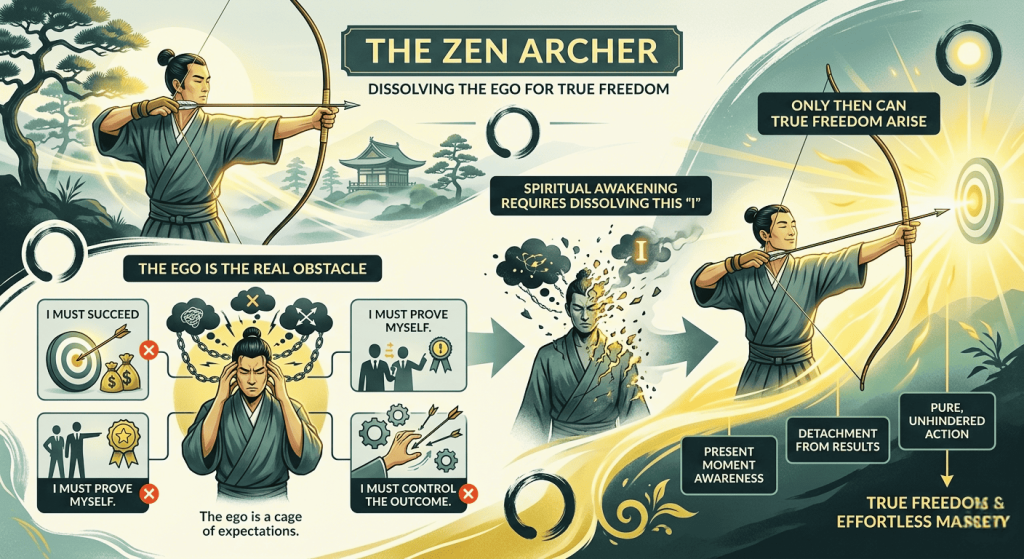
In the Zen Archer story, the biggest barrier isn’t skill—it’s the ego.
The ego constantly says the following:
- “I must succeed”
- “I must prove myself.”
- “I must control the outcome.”
But spiritual awakening requires dissolving this “I”.
Only then can true freedom arise.
Lesson 4 – Mastery Comes from Within
External techniques can only take you so far.
True mastery comes from:
- Inner stillness
- Deep awareness
- Alignment with the present moment
This applies not just to archery but to life itself.
How The Zen Archer Story Supports Spiritual Awakening (Practical Application)
Applying the Teaching in Daily Life
You don’t need a bow and arrow to practise Zen.
You can apply these lessons in everyday situations:
- Work without obsessing over results
- Focus on the process rather than the outcome
- Stay present during conversations
- Accept uncertainty without resistance
These small shifts create profound changes over time.
Meditation Techniques Inspired by The Zen Archer
Here are simple practices you can start today:
1. Breath Awareness
Focus on your breathing. Don’t control it—just observe.
2. Effortless Focus
Choose a task and perform it without forcing perfection.
3. Thought Observation
Watch your thoughts come and go without reacting.
These techniques align with traditional Zen practices and gradually lead to deeper awareness.
Letting Go in Real-Life Situations
The hardest part of spiritual awakening is letting go.
But it’s also the most powerful.
Apply this principle to:
- Relationships (release expectations)
- Career (focus on effort, not results)
- Personal growth (accept your current state)
When you stop resisting, life flows more naturally.
Why The Zen Archer Story Still Matters Today
In today’s high-pressure world, stress and burnout are common.
People are constantly chasing the following:
- Success
- Recognition
- Validation
But the Zen Archer story offers a different path.
It reminds us that:
- Peace comes from within
- Control is an illusion
- True success is inner harmony
This message is more relevant now than ever.
Common Misinterpretations of The Zen Archer Story
Myth 1: It Promotes Laziness
Wrong.
Zen is not about avoiding effort—it’s about removing unnecessary effort.
Myth 2: It Means “Don’t Care About Results”
Not exactly.
You still act—but without attachment.
Myth 3: It Encourages Passivity
Zen is highly disciplined.
It requires deep awareness, not passivity.
Conclusion: The True Meaning Behind The Zen Archer
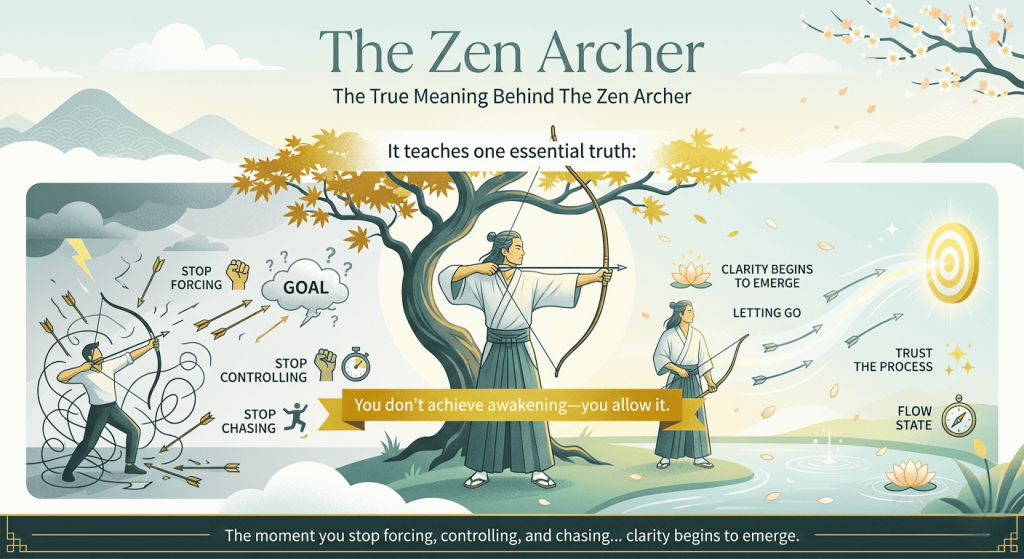
So, what is the story of The Zen Archer, and how does it support spiritual awakening?
It teaches one essential truth:
You don’t achieve awakening—you allow it.
The moment you stop forcing, controlling, and chasing… clarity begins to emerge.
Call to Action
Start small:
- Take one task today and do it mindfully
- Notice where you’re forcing outcomes
- Practice letting go—even briefly
If you stay consistent, you’ll begin to experience the same transformation as the Zen Archer.