What Is the Story of The Former Prince Bhaddiya, and How Does It Support Spiritual Awakening in 2026?
Introduction
In a world driven by success, security, and material comfort, the idea of walking away from everything can feel almost unthinkable. Yet, some of the most powerful spiritual transformations in history began with exactly that decision.
One such story is that of Former Prince Bhaddiya—a royal figure who had everything most people spend their lives chasing, yet chose to abandon it all in search of something deeper. But why? And more importantly, what can you learn from it?
If you’ve ever wondered what true inner peace looks like—or why external success sometimes feels empty—this story offers surprisingly practical answers. In this article, we’ll explore what the story of The Former Prince Bhaddiya is and how it supports spiritual awakening, while also breaking down actionable lessons you can apply in your own life.
What Is the Story of The Former Prince Bhaddiya? (Overview)
The story of Bhaddiya comes from early Buddhist teachings associated with the Lord Gautama Buddha. Bhaddiya was a prince—wealthy, powerful, and surrounded by luxury. From the outside, his life appeared perfect.
But internally, it was a different story.
Despite living under constant protection, guarded by soldiers and surrounded by comfort, Bhaddiya lived in fear. Fear of loss. Fear of danger. Fear of uncertainty.
Eventually, he made a radical decision: he renounced his royal life and became a monk. What followed shocked those around him.
Instead of regret, Bhaddiya repeatedly exclaimed:
“Oh, what happiness!”
This wasn’t the happiness of comfort—it was the happiness of freedom.
Who Was Prince Bhaddiya? (Historical Context)
His Royal Background
Bhaddiya was born into privilege. As a prince, he had access to everything—security, wealth, status, and influence. His life was carefully structured to ensure safety and comfort.
From a modern perspective, his life mirrors what many strive for: financial success, social status, and control over circumstances.
But here’s the paradox: even with all of that, he lacked peace.
His Decision to Renounce Palace Life
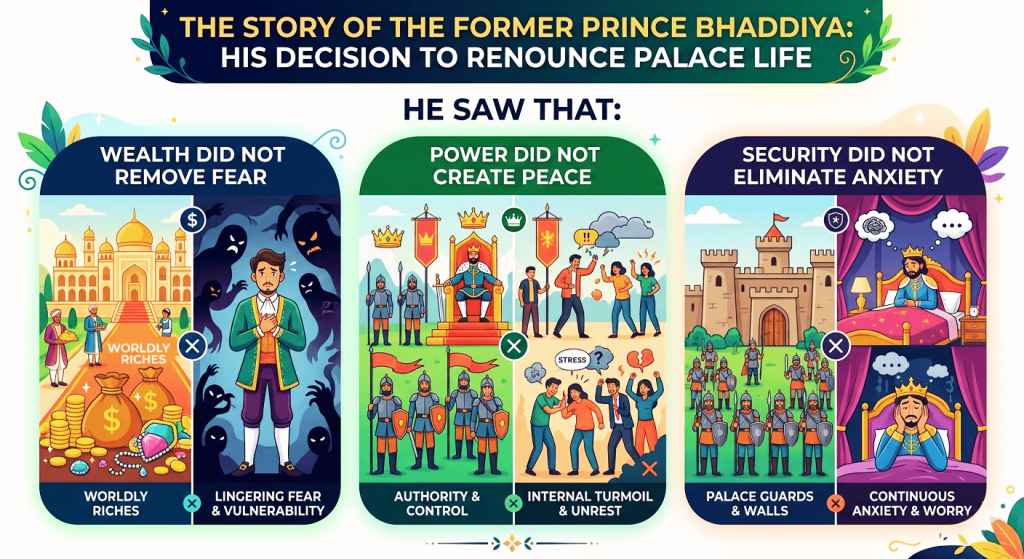
Bhaddiya’s turning point came through exposure to spiritual teachings and the realisation that his external life was not aligned with inner freedom.
He saw that:
- Wealth did not remove fear
- Power did not create peace
- Security did not eliminate anxiety
So he did something radical—he walked away.
This wasn’t an act of rejection. It was an act of clarity.
The Key Turning Point in Bhaddiya’s Story
From Fear to Freedom
While living in the palace, Bhaddiya was constantly guarded. Ironically, the more protection he had, the more fear he felt.
Why?
Because attachment creates vulnerability.
The more you have, the more you fear losing it.
After becoming a monk, Bhaddiya lived with almost nothing. Yet, for the first time, he felt safe.
Not because the world changed, but because his relationship to it changed.
The Famous Realisation: “Oh, What Happiness!”
Bhaddiya’s repeated expression—“Oh, what happiness!”—became central to his story.
To outsiders, it seemed confusing. How could someone who gave up everything feel happier?
But this statement reflects a profound shift:
- From dependence to independence
- From fear to freedom
- From external validation to internal stability
This is the essence of spiritual awakening.
What Does the Story of The Former Prince Bhaddiya Teach About Spiritual Awakening?
1. Letting Go of External Attachments
One of the clearest lessons is that attachment—not possession—is the root of suffering.
You don’t need to give up everything. But you do need to examine your dependence on it.
Ask yourself:
- Do I rely on external things for happiness?
- What happens if I lose them?
Bhaddiya’s story challenges the assumption that more equals better.
2. Inner Peace Comes from Within
Bhaddiya didn’t find peace by changing his environment—he found it by changing his mind.
This aligns with a core spiritual principle:
Peace is not found. It is realised.
No amount of success can replace inner clarity.
3. True Security Is Mental, Not Physical
Modern life often prioritises security—jobs, savings, systems, routines.
But Bhaddiya’s experience exposes a deeper truth:
- External security can coexist with internal fear
- Internal freedom eliminates fear regardless of circumstances
This shift is critical for spiritual awakening.
Step-by-Step: Applying Bhaddiya’s Lessons to Your Spiritual Awakening
This is where the story becomes practical.
Step 1 – Identify Your Attachments
Start by observing what you feel you “need” to be okay.
Common examples:
- Money
- Relationships
- Status
- Control
Awareness is the first step toward freedom.
Step 2 – Simplify Your Life
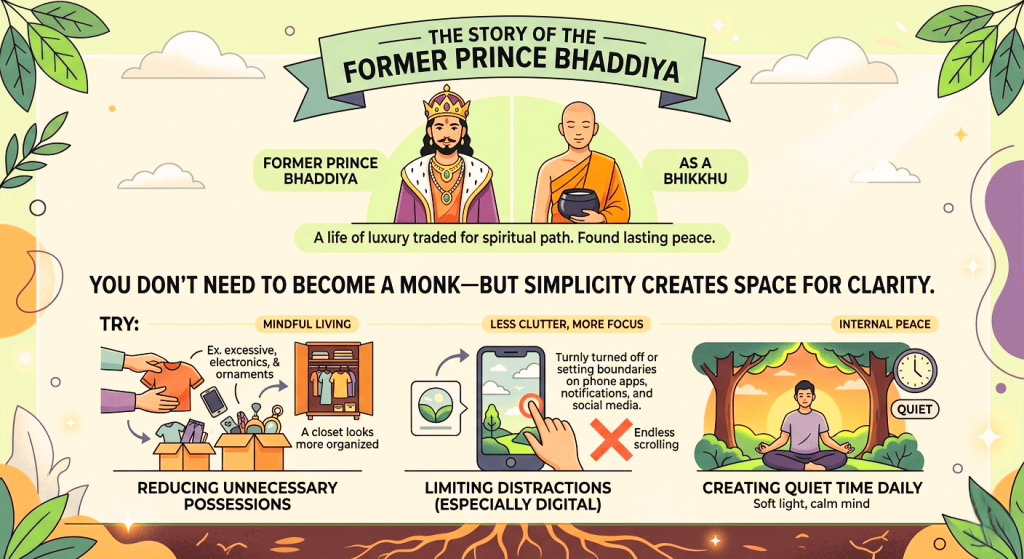
You don’t need to become a monk—but simplification helps.
Try:
- Reducing unnecessary possessions
- Limiting distractions (especially digital)
- Creating quiet time daily
Simplicity creates space for clarity.
Step 3 – Practise Mindfulness Daily
Mindfulness anchors you in the present moment.
Start small:
- 5–10 minutes of breathing awareness
- Observing thoughts without judgment
- Being fully present in simple activities
Consistency matters more than duration.
Step 4 – Reframe Happiness
Instead of asking:
“What will make me happy?”
Ask:
“What am I depending on for happiness?”
This subtle shift changes everything.
Step 5 – Embrace Inner Freedom
Inner freedom means:
- You are not controlled by fear
- You are not dependent on outcomes
- You are at peace regardless of circumstances
This is the state Bhaddiya discovered.
Why This Ancient Story Still Matters Today
At first glance, Bhaddiya’s story may feel distant from modern life, but it’s more relevant than ever.
Today’s world is characterised by the following:
- Constant stimulation
- Pressure to succeed
- Fear of missing out
- Emotional burnout
Many people achieve success but still feel restless.
Bhaddiya’s story provides a counter-narrative:
You don’t need more. You need less attachment.
For readers in fast-paced environments—especially in places like the USA—this message is both challenging and necessary.
Common Misinterpretations of Bhaddiya’s Story
It’s Not About Rejecting Wealth Completely
A common mistake is assuming the story promotes extreme renunciation.
It doesn’t.
The real message is about non-attachment, not deprivation.
You can have wealth without being controlled by it.
It’s About Mindset, Not Status
Bhaddiya’s transformation wasn’t about becoming poor—it was about becoming free.
Spiritual awakening is not a lifestyle change—it’s a perspective shift.
Conclusion: What Is the Story of The Former Prince Bhaddiya, and How Does It Support Spiritual Awakening?
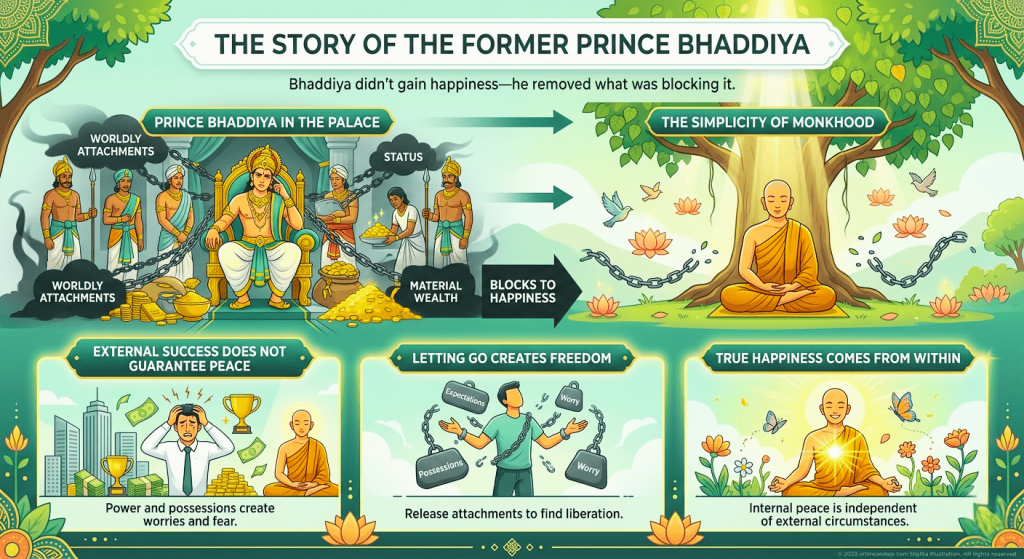
The story of Former Prince Bhaddiya is not just a historical account—it’s a practical blueprint for inner transformation.
It shows that:
- External success does not guarantee peace
- Letting go creates freedom
- True happiness comes from within
Bhaddiya didn’t gain happiness—he removed what was blocking it.
Call-to-Action
If you want to begin your own journey:
- Take 5 minutes today to sit in silence
- Reflect on what you’re holding onto
- Start letting go—one layer at a time
And if this story resonated with you, explore more teachings that challenge how you define happiness.