What Is the Zen Story of “Original Face”, and How Does It Support Spiritual Awakening in 2026?
Introduction
Who were you before the world gave you a name, a role, and an identity?
This question sits at the heart of one of Zen Buddhism’s most intriguing teachings—the “Original Face” koan. At first glance, it sounds abstract, even confusing. But beneath its simplicity lies a profound tool for spiritual awakening, one that has guided seekers for centuries.
In today’s fast-paced, identity-driven world, many people feel disconnected from their true selves. We define ourselves by careers, relationships, achievements, and even social media personas. But what if all of that is just surface-level?
This article explores what the Zen story of “Original Face” really means, how it works as a spiritual practice, and how you can apply it in your daily life to experience deeper clarity, peace, and self-awareness.
What Is the Zen Story of “Original Face”?
The Original Koan Explained
The “Original Face” is a classic Zen koan that asks the following:
“What was your original face before your parents were born?”
At first, the question seems impossible. How can you have a “face” before you even existed?
That’s exactly the point.
A koan is not meant to be solved logically. Instead, it’s designed to interrupt your normal thinking patterns and push you beyond intellectual reasoning. Zen masters use koans to trigger direct insight—an experience of truth rather than an explanation of it.
Historical Background of the “Original Face” Koan
The “Original Face” koan originates from the Zen (Chan) Buddhist tradition, which began in China and later spread to Japan.
Zen emphasises direct experience over theory. Instead of relying on scriptures or philosophical debate, practitioners are encouraged to look inward and discover truth for themselves.
Koans became a central teaching method in Zen monasteries. Students would meditate on them for years, sometimes decades, until a moment of clarity—often called kensho (seeing one’s true nature)—arose.
What Does “Original Face” Mean in Zen Philosophy?
Beyond Identity and Ego
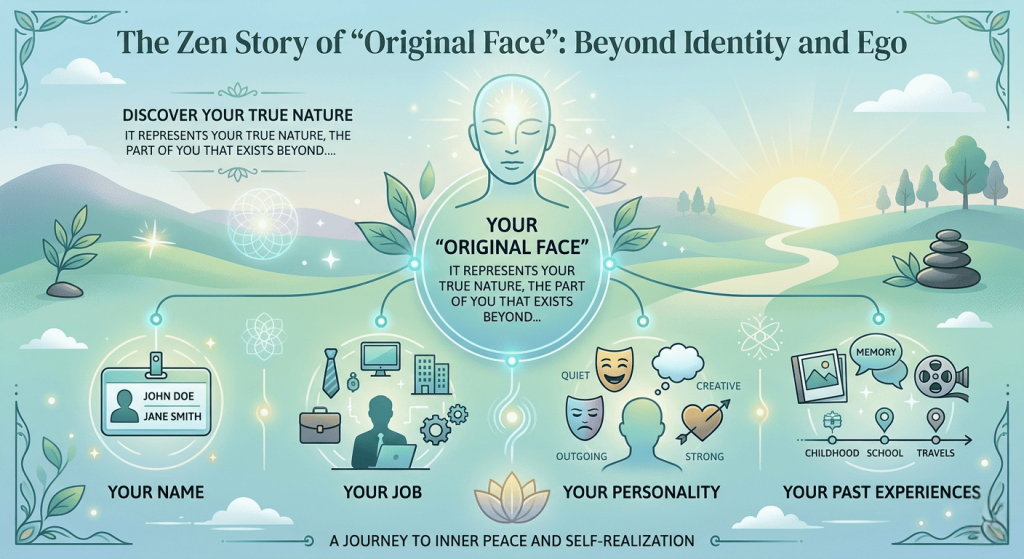
Your “Original Face” is not a physical face. It represents your true nature, the part of you that exists beyond:
- Your name
- Your job
- Your personality
- Your past experiences
From a Zen perspective, everything you typically identify with is constructed. These layers form your ego—useful for functioning in the world, but not your ultimate reality.
The koan asks you to look beyond all of that.
The Concept of True Nature
Zen teachings often point to something called Buddha-nature—the idea that every person already possesses an inherent state of awareness, clarity, and completeness.
Your “Original Face” is this pure awareness, untouched by conditioning.
It’s the version of you that exists:
- Before thoughts arise
- Before judgments form
- Before identity takes shape
You don’t have to create it. You just have to recognise it.
How the “Original Face” Koan Supports Spiritual Awakening
Breaking Logical Thinking Patterns
Most of us rely heavily on logic and analysis. While useful, these tools can limit more profound understanding.
The “Original Face” koan disrupts this pattern. When you try to answer it logically, you hit a wall. That frustration is intentional—it forces the mind to let go of control.
In that gap, something new can emerge: direct awareness.
Awakening to Present-Moment Awareness
Spiritual awakening is not about gaining something new—it’s about becoming fully present.
When you sit with the koan, your attention naturally shifts:
- Away from past stories
- Away from future worries
- Toward the present moment
In that presence, you begin to experience life more directly, without the constant filter of thought.
Dissolving the Ego
The ego thrives on identity: “I am this” and “I am that”.
But the koan quietly challenges all of it.
As you explore the question, you may notice:
- Your identity feels less solid
- Your thoughts lose their grip
- Your sense of separation begins to soften
This is not about destroying the ego—it’s about seeing through it.
Step-by-Step Guide to Practicing the “Original Face” Meditation
This is where theory becomes practice. Here’s how you can work with the koan in a practical, accessible way.
Step 1 – Create a Quiet Space
Find a place where you won’t be disturbed. It doesn’t need to be perfect—just quiet enough to focus.
Sit comfortably, keeping your spine upright but relaxed.
Step 2 – Focus on the Koan
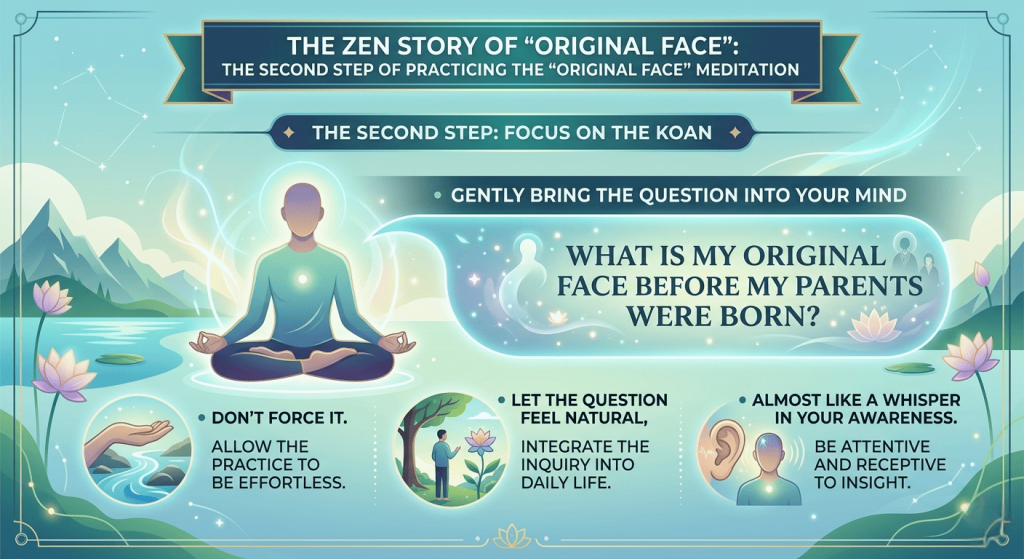
Gently bring the question into your mind:
“What is my original face before my parents were born?”
Don’t force it. Let the question feel natural, almost like a whisper in your awareness.
Step 3 – Observe Without Answering
This is the most important step.
Your mind will try to answer the question. It may produce thoughts, images, or interpretations. Let them pass.
Do not settle on any answer.
Instead, stay with the feeling of not knowing.
Step 4 – Sit with Awareness
As you continue, your attention may shift from the question itself to a deeper sense of awareness.
You may notice:
- Silence between thoughts
- A sense of spaciousness
- A quiet presence
Rest there.
Step 5 – Integrate Insight into Daily Life
Meditation doesn’t end when you stand up.
Throughout your day, gently return to the question:
- Who am I beyond this role?
- What remains when I stop labelling everything?
Over time, this awareness begins to influence how you think, act, and relate to others.
Common Misunderstandings About the “Original Face” Koan
It’s Not a Riddle to Solve
Many beginners treat the koan like a puzzle.
But there is no correct answer you can explain in words. The “answer” is an experience, not a conclusion.
Awakening is Not Instant
While some people have sudden insights, for most, this is a gradual process.
Consistency matters more than intensity.
It’s Not About Rejecting Identity
You don’t need to abandon your life, career, or relationships.
Instead, you learn to engage with them without being defined by them.
Practical Benefits of Understanding Your “Original Face”
Increased Self-Awareness
You begin to notice your thoughts and emotions more clearly, without immediately reacting to them.
Inner Peace and Clarity
As mental noise decreases, a natural sense of calm emerges.
You’re less affected by external circumstances.
Freedom from Limiting Beliefs
When you see that identity is flexible, you’re no longer trapped by the following:
- “I’m not good enough”
- “I can’t change”
- “This is just who I am.”
How to Apply the Teaching in Modern Life
In Work and Career
Instead of tying your worth to your job title, you operate from a deeper sense of stability.
This often leads to better decisions and less stress.
In Relationships
When you’re not locked into rigid identities, you become more open and understanding.
You see others beyond labels and expectations.
In Personal Growth
Rather than constantly trying to “fix” yourself, you begin to recognise that nothing essential is missing.
Growth becomes more natural and less forced.
Conclusion
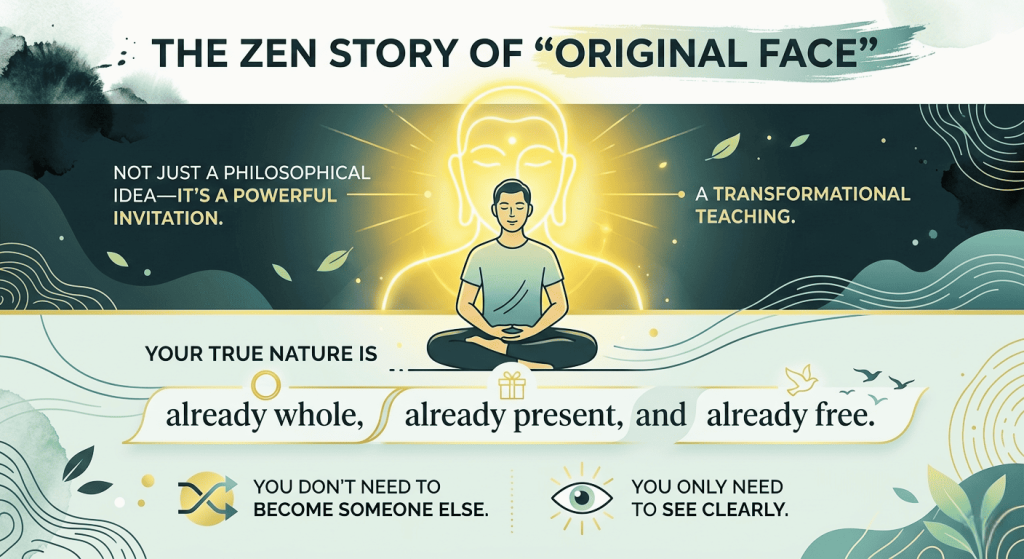
The Zen story of “Original Face” is not just a philosophical idea—it’s a powerful invitation.
An invitation to look beyond everything you think you are…
And discover what remains.
At its core, the teaching points to a simple but transformative truth:
Your true nature is already whole, already present, and already free.
You don’t need to become someone else.
You only need to see clearly.
Call-to-Action
Take a few minutes today and sit quietly with the question:
“What is my original face?”
Don’t rush to answer it.
Let it open something deeper within you.
And if you found this helpful, explore more spiritual teachings or share your experience—because sometimes, insight grows stronger when it’s expressed.