
What is the Story of The Empty Boat (Taoist Story), and How Does It Support Spiritual Awakening in 2026?
Introduction
In a world filled with stress, misunderstandings, and emotional reactions, many people are searching for deeper peace and clarity. This search often leads to spiritual awakening—a process of becoming more aware of your thoughts, emotions, and true nature.
One of the most powerful yet simple teachings that supports this journey comes from ancient Taoist wisdom: ‘The Empty Boat’. At first glance, it’s just a short story. But when understood deeply, it reveals a profound truth about ego, perception, and inner peace.
So, what is the story of The Empty Boat (Taoist story), and how does it support spiritual awakening? Let’s explore its meaning, its roots, and how you can apply it to your everyday life.
What is the Story of The Empty Boat (Taoist Story)?
The story goes like this:
A man is rowing his boat across a river. The water is calm, and everything feels peaceful—until suddenly, another boat crashes into his.
Instantly, he becomes furious. He starts shouting angrily at the person in the other boat:
“Watch where you’re going! Are you blind?”
But as the boat drifts closer, he realizes something unexpected…
The boat is empty.
In that moment, his anger disappears. There is no one to blame, no one to shout at, no one to hold responsible.
The situation hasn’t changed—but his reaction has.
Origin of The Empty Boat in Taoism
This story is often attributed to Zhuangzi, one of the most influential thinkers in Taoism. His teachings focus on flowing with life, letting go of rigid control, and transcending the ego.
Taoism emphasises harmony with the natural way of the universe—the Tao. Stories like The Empty Boat are designed to shift your perception rather than just inform your intellect.
What is the Deeper Meaning Behind The Empty Boat?
At its core, The Empty Boat is not about boats or rivers—it’s about how we react to life.
The empty boat represents a powerful idea: most of our anger comes from assuming things are personal.
When the man believed someone was inside the boat, he reacted with anger. But when he realised it was empty, his anger vanished.
This reveals something critical:
It’s not the event that causes suffering—it’s our interpretation of it.
The Role of Ego in Human Suffering

The ego is the part of us that constantly says:
- “This shouldn’t happen to me.”
- “They disrespected me.”
- “I deserve better.”
When we think someone intentionally caused us harm, our ego reacts defensively.
But what if most situations are like the empty boat?
- Someone cuts you off in traffic → Maybe they didn’t see you
- A colleague seems rude → Maybe they’re dealing with stress
- A friend doesn’t reply → Maybe they’re busy
The ego personalises everything. Spiritual awakening begins when you stop doing that.
Letting Go of Control and Expectations
Another layer of this story is about expectations.
We expect:
- People to behave a certain way
- Life to go according to our plans
- Situations to be fair and predictable
When reality doesn’t match expectations, frustration arises.
The empty boat reminds us.
Not everything is about you—and not everything is under your control.
Letting go of this illusion creates space for peace.
How Does The Empty Boat Story Support Spiritual Awakening?
Spiritual awakening is not about becoming someone new—it’s about seeing clearly.
The Empty Boat supports this process in several powerful ways.
1. Developing Emotional Awareness
The story helps you notice your emotional triggers.
Instead of reacting instantly, you begin to ask:
- “Why am I angry?”
- “Am I assuming intention?”
This shift from reaction to awareness is a key step in awakening.
2. Practising Non-Resistance
Most suffering comes from resisting reality.
- “This shouldn’t be happening.”
- “They shouldn’t act like this.”
But reality is already happening.
The empty boat teaches the following:
Accept first. React later—if needed.
This doesn’t mean being passive. It means responding consciously instead of reacting unconsciously.
3. Cultivating Inner Peace Through Detachment
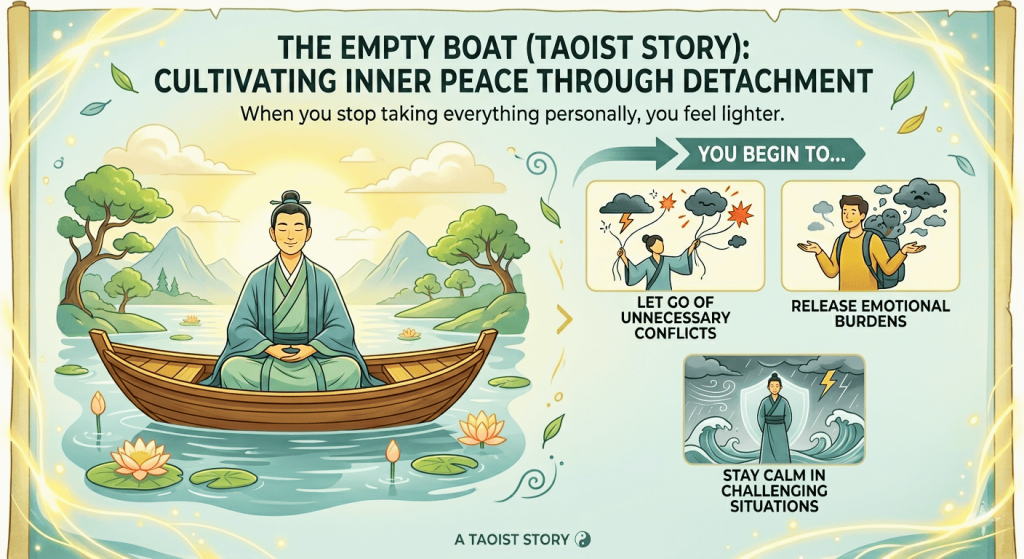
When you stop taking everything personally, something incredible happens:
You feel lighter.
Detachment doesn’t mean you stop caring—it means you stop clinging.
You begin to
- Let go of unnecessary conflicts
- Release emotional burdens
- Stay calm in challenging situations
This is the essence of inner peace.
Practical Ways to Apply The Empty Boat Teaching in Daily Life
Understanding the story is one thing. Living it is another.
Here’s how you can apply it practically:
Pause Before Reacting
When something triggers you:
- Take a deep breath
- Count to five
- Observe your reaction
This small pause can prevent unnecessary conflict.
Question Your Assumptions
Ask yourself:
- “Am I sure this was intentional?”
- “Could there be another explanation?”
This simple shift reduces emotional overreaction.
Practise Ego Awareness Daily
Notice when your ego speaks:
- “They disrespected me.”
- “I look bad.”
Instead of believing it immediately, observe it.
Journaling or meditation can help build this awareness.
Use The Empty Boat as a Mental Reminder
Whenever you feel triggered, imagine:
“What if this is just an empty boat?”
This mental image can instantly soften your reaction.
Common Misinterpretations of The Empty Boat Story
While the teaching is powerful, it’s often misunderstood.
Myth 1: It Means Suppressing Emotions
Not true.
You’re not ignoring emotions—you’re understanding them.
Awareness is different from suppression.
Myth 2: It Encourages Passivity
Also false.
You can still take action when needed. The difference is:
- Reacting emotionally vs responding consciously
Myth 3: Nothing Matters
The teaching doesn’t say life is meaningless.
It says:
Don’t create unnecessary suffering through misinterpretation.
Why Ancient Taoist Wisdom Still Matters Today

Even though this story is centuries old, its relevance has only increased.
In today’s world:
- Social media amplifies misunderstandings
- Stress levels are higher than ever
- People react quickly without reflection
The Empty Boat offers a counterbalance:
- Pause
- Reflect
- Don’t take everything personally
It’s a timeless tool for modern life.
Conclusion
Therefore what is the story of The Empty Boat (Taoist story), and how does it support spiritual awakening?
It’s a simple story with a profound message:
Most of our suffering comes from believing everything is personal.
When you realise that many situations are like an “empty boat,” your anger fades, your ego softens, and your mind becomes peaceful.
Spiritual awakening begins the moment you stop reacting blindly and start seeing clearly.
Call-to-Action
Next time something triggers you, pause and ask the following:
“Is the situation really personal… or is it just an empty boat?”
If this insight resonated with you:
- Share it with someone who needs it
- Practice it today
- Explore more teachings that support your awakening journey