
What Is the Zen Story of “No Mind” (Mushin), and How Does It Support Spiritual Awakening in 2026?
Introduction
In a world filled with constant notifications, endless thoughts, and emotional overwhelm, the idea of having a quiet, clear mind can feel almost impossible. Many people spend their days trapped in overthinking—replaying the past or worrying about the future—without ever truly experiencing the present moment.
This is where the Zen concept of “No Mind”, known as “Mushin“, offers a powerful shift.
But what is the Zen story of “No Mind” (Mushin), and how does it support spiritual awakening?
At its core, Mushin is not about having no thoughts at all. Instead, it refers to a state of effortless awareness—where your mind is not cluttered by fear, ego, or distraction. It is a way of being fully present, acting naturally without hesitation or internal conflict.
In this article, you’ll discover the meaning of Mushin, explore a classic Zen story that illustrates it, and learn practical ways to apply it in your daily life to support spiritual awakening.
What Is the Zen Story of “No Mind” (Mushin), and How Does It Support Spiritual Awakening?
“Mushin”, often translated as “No Mind”, comes from Zen philosophy and Japanese martial traditions. It describes a mental state where a person is fully aware and responsive, yet free from unnecessary thought.
This doesn’t mean your mind becomes blank. Instead, your thoughts no longer control you.
Imagine performing an action so naturally that you don’t have to think about it—like catching a ball or reacting instantly in a moment of danger. That is a glimpse of Mushin.
In spiritual terms, Mushin allows you to:
- Experience reality without distortion
- Let go of ego-driven reactions
- Become deeply present in each moment
This is why Mushin plays a key role in spiritual awakening—it removes the mental barriers that prevent clarity and inner peace.
The Meaning of Mushin in Zen Philosophy
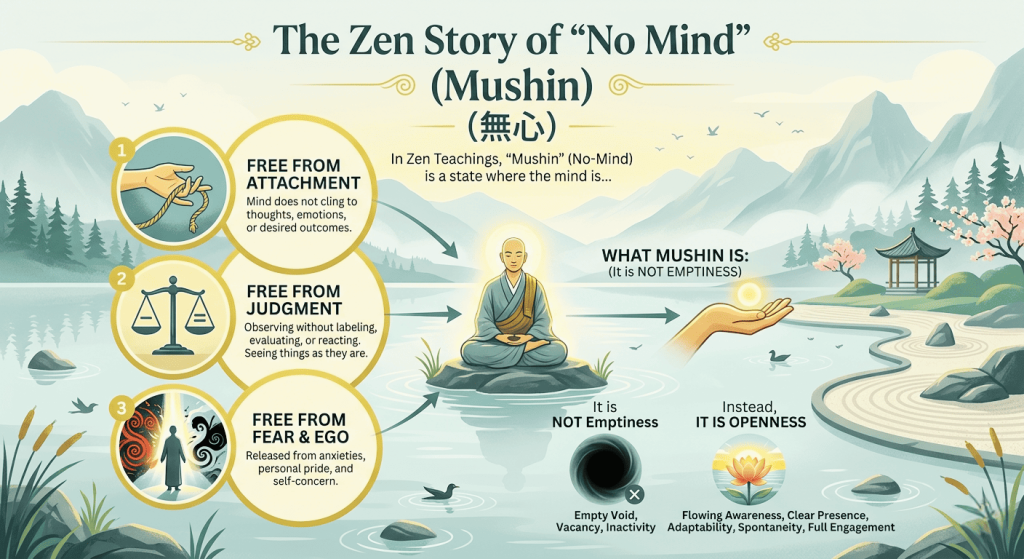
In Zen teachings, “Mushin” is a state where the mind is:
- Free from attachment
- Free from judgment
- Free from fear and ego
It is not emptiness in a negative sense. Instead, it is openness—like a clear sky that allows everything to pass through without resistance.
Zen practitioners believe that suffering comes from attachment to thoughts and emotions. Mushin dissolves that attachment.
This concept is also deeply connected to disciplines like martial arts, where reacting too slowly—or thinking too much—can lead to failure. The best practitioners act instantly, without hesitation. Their mind is present, but not cluttered.
That is Mushin in action.
The Zen Story Behind “No Mind” (Mushin)
One of the most well-known stories illustrating Mushin involves a young student and a master swordsman.
A student once asked a master how he could become the greatest swordsman. The master replied, “Stop trying to win.”
Confused, the student continued to train, but he was obsessed with success. During practice, he hesitated, overthought his moves, and often lost.
One day, the master attacked him unexpectedly while he was doing a simple task. Without thinking, the student reacted instantly and blocked the strike perfectly.
The master smiled and said, “That is it. That is No Mind.”
The Story Explained in Simple Terms
The student failed when he was thinking too much—trying to be perfect, trying to win, trying to control the outcome.
But when he stopped thinking and simply responded naturally, he performed flawlessly.
This moment revealed the essence of Mushin:
- No hesitation
- No fear
- No ego
Just pure awareness and action.
Hidden Lessons in the Zen Story
This simple story carries powerful lessons:
1. Letting Go of Ego
The student’s desire to be “the best” blocked his progress. Ego creates pressure and fear.
2. Acting Without Overthinking
Over-analysis slows you down and disconnects you from the present.
3. Trusting Natural Intelligence
Your body and mind already know how to respond—you just need to stop interfering.
How Mushin Supports Spiritual Awakening
Spiritual awakening is often described as a shift in awareness—a deeper understanding of reality beyond the ego.
Mushin directly supports this process.
Letting Go of Ego and Attachment
The ego constantly creates narratives:
- “I must succeed”
- “I am not good enough”
- “What will others think?”
These thoughts create suffering.
Mushin dissolves these patterns by removing identification with them. When you are no longer controlled by ego, you experience freedom.
Living Fully in the Present Moment
Mushin brings you into the now.
Instead of being lost in thoughts, you become aware of:
- Your breath
- Your surroundings
- Your actions
This presence is the foundation of spiritual awakening.
Reducing Mental Noise and Suffering
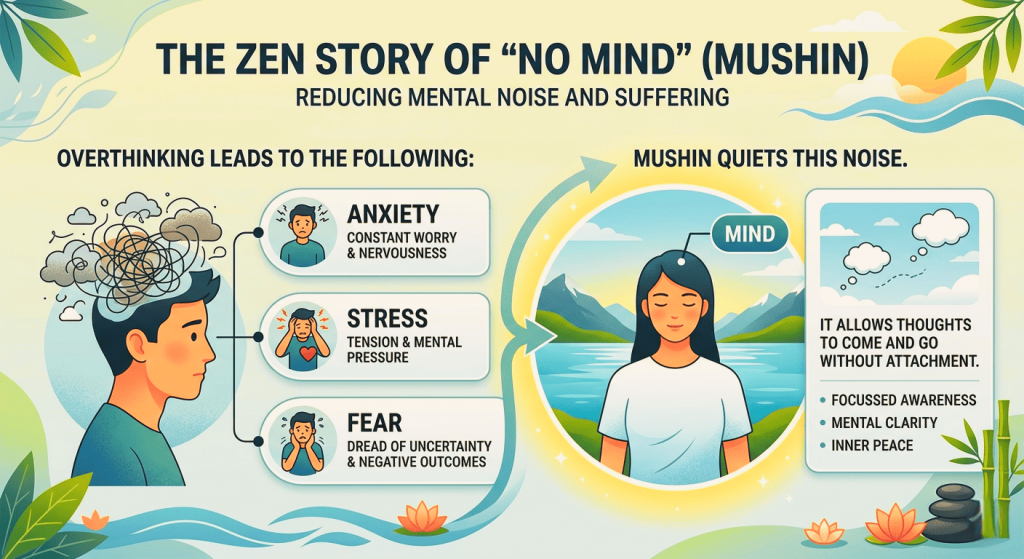
Most suffering is not caused by reality—it is created by the mind.
Overthinking leads to the following:
- Anxiety
- Stress
- Fear
Mushin quiets this noise. It allows thoughts to come and go without attachment.
The result is a deep sense of calm and clarity.
Practical Ways to Practise “No Mind” (Mushin) Daily
Understanding Mushin is one thing. Experiencing it is another.
Here are practical ways to begin.
Meditation Techniques for Mushin
Start with simple observation:
- Sit quietly and focus on your breath
- Notice thoughts as they arise
- Do not judge or follow them
- Let them pass naturally
The goal is not to stop thinking but to stop clinging to thoughts.
Mindful Activities in Everyday Life
You don’t need to sit in meditation all day.
Practise Mushin during daily tasks:
- Eat without distractions
- Walk while noticing each step
- Focus fully on one task at a time
This builds awareness and reduces mental clutter.
Letting Go of Control
Much of our stress comes from trying to control everything.
Practice:
- Accepting uncertainty
- Releasing expectations
- Trusting the flow of life
This creates space for Mushin to emerge naturally.
Common Misconceptions About Mushin
Many people misunderstand Mushin.
Let’s clear that up.
Mushin does not mean having zero thoughts
Thoughts still arise—but they don’t control you.
It is not laziness or passivity
In fact, Mushin leads to more effective action.
It does not remove intelligence
It enhances clarity and decision-making.
Why Mushin Matters in Modern Life
For people living in fast-paced environments—especially in places like the United States—mental overload is common.
Mushin offers real benefits:
Improved Focus
You become more productive by eliminating distractions.
Better Emotional Balance
You react less impulsively and more calmly.
Clear Decision-Making
Without overthinking, you make better choices.
Reduced Stress
A quiet mind leads to a healthier life.
Conclusion & Call-to-Action
So, what is the Zen story of “No Mind” (Mushin), and how does it support spiritual awakening?
It is a reminder that true clarity comes not from controlling the mind but from freeing it.
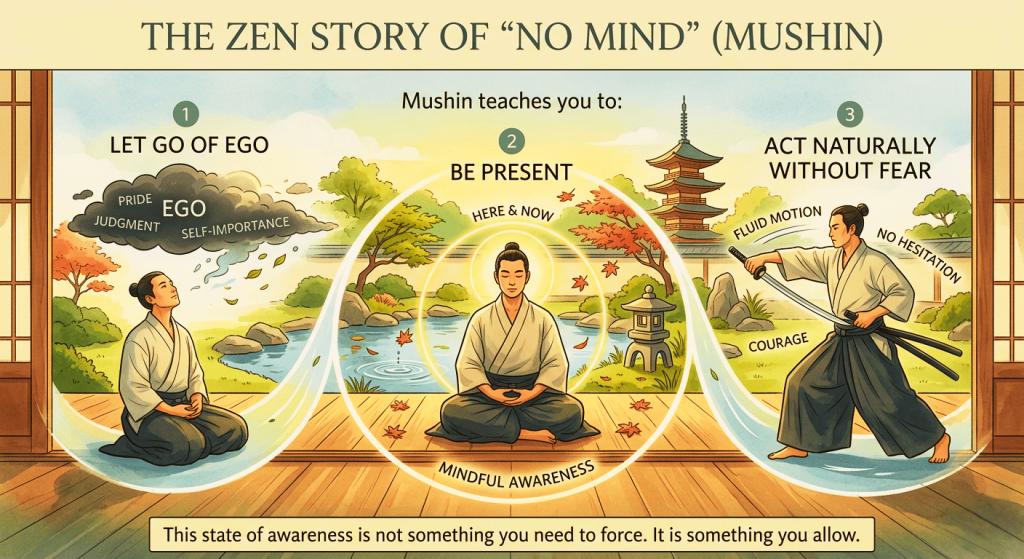
Mushin teaches you to:
- Let go of ego
- Be present
- Act naturally without fear
This state of awareness is not something you need to force. It is something you allow.
Start small.
Take a few minutes today to sit quietly, observe your thoughts, and experience the space between them.
That space is where transformation begins.
Ready to go deeper?
Try practising Mushin for just 5 minutes today—and notice how your awareness shifts.