
What is the Story of The Sound of One Hand (Zen Koan), and How Does It Support Spiritual Awakening in 2026?
Introduction
Have you ever heard the question, “What is the sound of one hand clapping?” At first, it sounds like a trick or even nonsense. But in Zen Buddhism, this famous koan is far from meaningless—it’s actually a powerful tool for transformation.
The story of the sound of one hand (Zen koan) has fascinated spiritual seekers for centuries. Rather than offering a logical answer, it invites you to step beyond thinking itself. And that’s exactly where spiritual awakening begins.
In this guide, you’ll discover the story behind this koan, what it really means, and how it can help you unlock more profound awareness in your daily life.
Table of Contents
What is the Sound of One Hand (Zen Koan)?
A Zen koan is a paradoxical question or statement used in meditation to push the mind beyond logical reasoning. These koans are rooted in the teachings of Gautama Buddha and later developed within Zen traditions in China and Japan.
The koan, “What is the sound of one hand?” is one of the most well-known. Unlike a typical question, it doesn’t have a straightforward answer. That’s intentional.
Why Koans Seem Illogical
Koans are designed to disrupt your normal thinking patterns. Your brain naturally tries to analyse, categorise, and solve problems. But spiritual awakening requires something different—direct experience without mental filters.
When you sit with a koan, your logical mind eventually reaches a dead end. And in that silence, something new can emerge.
The Story Behind the Sound of One Hand Koan
The story of the sound of one hand (Zen koan) originates from Zen master Hakuin Ekaku, who lived in 18th-century Japan.
According to tradition, Hakuin presented this koan to his students as a meditation practice. Instead of explaining it, he would ask:
“You know the sound of two hands clapping. Now tell me—what is the sound of one hand?”
The Student’s Journey
A student would begin by trying to answer intellectually:
- “Is it silence?”
- “Is it imagination?”
- “Is it a metaphor?”
But every answer would be rejected.
This process could go on for months—or even years. The student would feel frustration, confusion, and even self-doubt. Nevertheless, this struggle is the point.
The Master’s Teaching Method
Rather than giving answers, the master guides the student inward. The koan becomes a mirror, reflecting the limits of the thinking mind.
Eventually, when the student stops trying to solve the koan, a more profound realisation can arise—something beyond words.
What Does the Sound of One Hand Really Mean?

Here’s the crucial insight: the koan is not meant to be solved—it’s meant to be experienced.
The “sound of one hand” points to something beyond duality:
- Beyond sound and silence
- Beyond question and answer
- Beyond thinker and thought
Breaking the Ego Mind
Your ego thrives on certainty and control. It wants clear answers. But the koan denies that comfort.
As you sit with the question, your usual mental patterns begin to collapse. This creates space for awareness without interference.
Experiencing Reality Directly
In that space, you begin to experience reality as it is—without labels, judgements, or concepts. This is the essence of mindfulness and presence.
How the Sound of One Hand Supports Spiritual Awakening
The story of the sound of one hand (Zen koan) isn’t just philosophical—it’s deeply practical. It’s a tool designed to trigger awakening.
Enhancing Meditation Practice
When used in meditation, the koan sharpens your focus. Instead of letting your mind wander, you anchor it in a single question.
Over time, this builds concentration and inner stillness.
Letting Go of Control
One of the major obstacles in spiritual growth is the need to “figure everything out”. The koan teaches you to release that need.
You learn to sit with uncertainty—and even embrace it.
Awakening Insight (Satori)
In Zen, awakening is often described as satori—a sudden flash of insight.
This doesn’t come by thinking harder. It comes when thinking stops altogether.
The koan acts like a pressure point. When your mind finally lets go, insight can arise naturally.
How to Practice the Sound of One Hand Koan (Step-by-Step Tutorial)
If you want to experience the power of this koan, here’s a simple method to begin:
Step 1 – Sit in Stillness
Find a quiet place where you won’t be disturbed. Sit comfortably with your back straight.
Step 2 – Focus on Your Breath
Take slow, natural breaths. Let your body relax.
Step 3 – Introduce the Koan
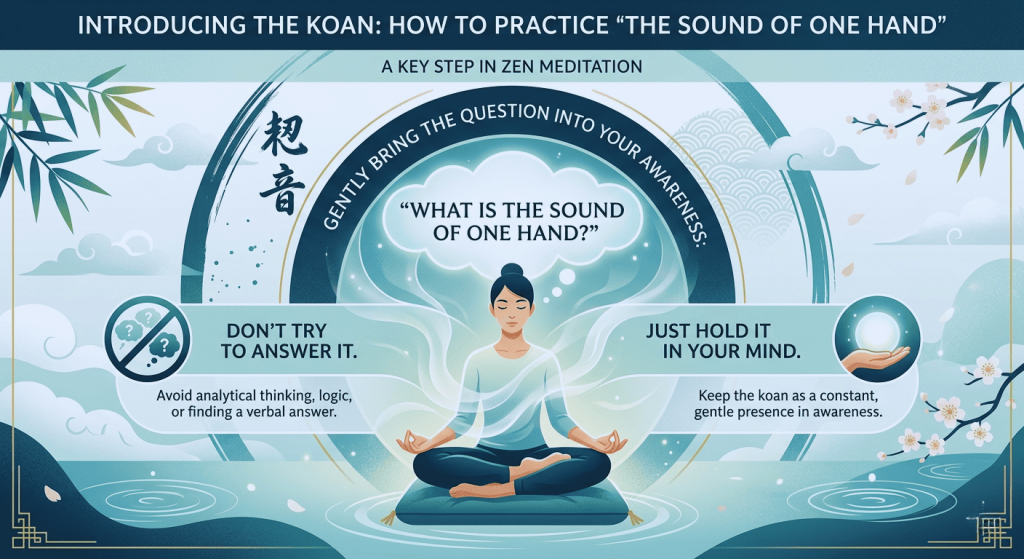
Gently bring the question into your awareness:
“What is the sound of one hand?”
Don’t try to answer it. Just hold it in your mind.
Step 4 – Observe Your Thoughts
Notice how your mind reacts:
- Does it try to solve the question?
- Does it get frustrated?
Simply observe without judgement.
Step 5 – Return to the Question
Each time your mind wanders, return to the koan.
Step 6 – Allow Silence to Deepen
Eventually, your thoughts may slow down. You might experience moments of pure awareness.
Stay there.
Step 7 – Practise Consistently
Like any skill, the process requires regular practice. Even 10–15 minutes daily can make a difference.
Common Misconceptions About the Sound of One Hand
Many beginners misunderstand this koan. Let’s clear up a few myths:
- “There must be a correct answer.”
→ No. The value lies in the process, not the answer. - “It’s just a riddle.”
→ It’s a spiritual tool, not a puzzle. - “You need to be intelligent to understand it.”
→ In fact, overthinking can slow you down.
Benefits of Practising Zen Koans in Modern Life

Even if you’re not deeply spiritual, koan practice can bring real-world benefits:
Reduced Stress
Letting go of constant thinking helps calm your nervous system.
Improved Focus
Training your mind to stay with one question improves concentration.
Greater Emotional Balance
You become less reactive and more present.
Freedom from Overthinking
You learn that not every question needs an answer.
Conclusion
The story of the sound of one hand (Zen koan) is not about finding an answer—it’s about discovering a new way of experiencing life.
By challenging your mind’s need for logic and certainty, this simple question opens the door to something much deeper: awareness, presence, and ultimately, spiritual awakening.
If you’re ready to explore beyond thinking, start with just a few minutes each day. Sit quietly, hold the question gently, and allow the experience to unfold.
Your awakening doesn’t come from answers—it comes from seeing beyond the need for them.
FAQs
What is the sound of one hand in Zen Buddhism?
The sound of one hand is a famous Zen koan designed to go beyond logical thinking. It doesn’t have a literal answer—it’s meant to guide you toward direct awareness.
Who created the sound of one hand koan?
The koan is commonly attributed to Zen master Hakuin Ekaku, who used it to train students in meditation and insight.
Is there a correct answer to the sound of one hand?
No, there isn’t a single correct answer. The purpose is not to solve it, but to experience a shift in awareness beyond thinking.
How does the sound of one hand relate to spiritual awakening?
It helps break down habitual thinking patterns, allowing deeper awareness and insight to arise naturally.
Can beginners practise Zen koans like this one?
Yes, beginners can practise it. In fact, simple koans like this are often used as entry points into meditation.
How long does it take to understand a koan?
There’s no fixed timeline. Some people gain insight quickly, while others may take months or years of practice.
Is the sound of one hand just about silence?
Not exactly. While silence may be part of the experience, the koan points to something beyond both sound and silence.
Do I need a teacher to practice this koan?
A teacher can help guide you, but you can also start practicing on your own through meditation and self-observation.
What happens when you “solve” the koan?
Instead of solving it intellectually, you experience a shift in perception—often described as clarity, peace, or sudden insight.
Can this koan help with stress and anxiety?
Yes. By reducing overthinking and encouraging mindfulness, it can help you feel calmer and more grounded in daily life.