
What Are The Four Noble Truths of Buddhism, and How Do They Support Spiritual Awakening in 2026?
Introduction
Many people begin their spiritual journey with a simple yet profound question: Why do we suffer, and how can we find true peace? Across cultures and centuries, spiritual traditions have attempted to answer this question. One of the most influential explanations comes from Buddhism through the teaching known as the Four Noble Truths.
Understanding what are the Four Noble Truths of Buddhism and how do they support spiritual awakening can offer deep insights into human nature, emotional well-being, and inner peace. These teachings were first introduced by Siddhartha Gautama, known as the Buddha, over 2,500 years ago after he attained enlightenment. Despite their ancient origins, the Four Noble Truths remain highly relevant today, especially for people seeking clarity, mindfulness, and spiritual growth.
Rather than presenting abstract religious ideas, the Four Noble Truths function as a practical guide to understanding suffering and transforming the mind. They explain why dissatisfaction exists in life and provide a path toward freedom from that suffering.
In this article, we will explore the Four Noble Truths in depth and discover how they can support a genuine spiritual awakening in modern life.
What are The Four Noble Truths of Buddhism?
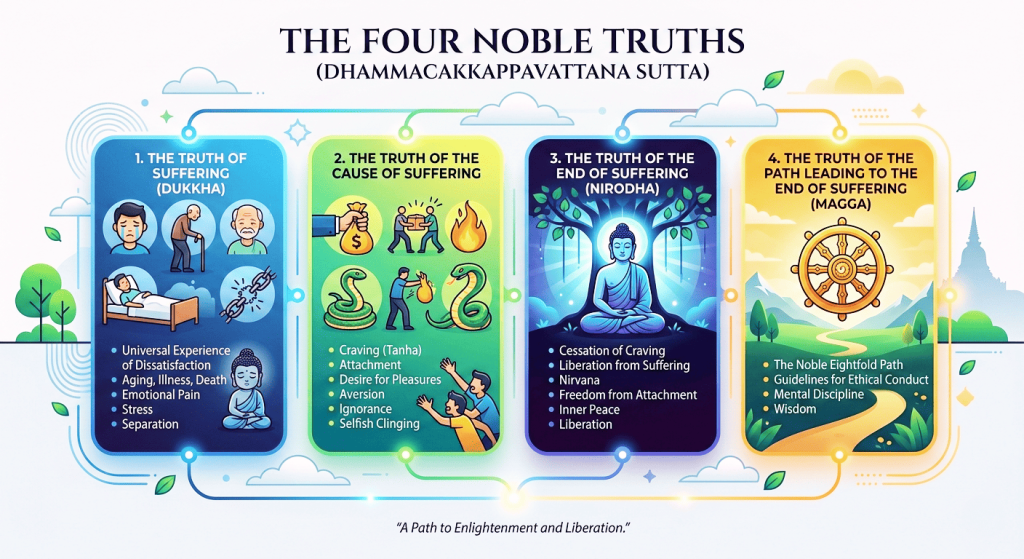
The Four Noble Truths are considered the foundation of Buddhist philosophy. They form the core teaching that explains the nature of suffering and the path to liberation from it.
The Buddha introduced these truths during his first sermon after enlightenment, often referred to as the “Dhammacakkappavattana Sutta,” or the turning of the wheel of Dharma.
The Four Noble Truths are:
- The Truth of Suffering (Dukkha)
- The Truth of the Cause of Suffering
- The Truth of the End of Suffering
- The Truth of the Path Leading to the End of Suffering
Together, these truths create a structured approach to understanding life’s challenges. Instead of avoiding discomfort or denying suffering, Buddhism encourages people to observe it carefully, understand its origins, and work toward liberation from it.
For those seeking spiritual awakening, the Four Noble Truths serve as a roadmap that leads from confusion and dissatisfaction to clarity and peace.
The First Noble Truth – Understanding Suffering (Dukkha)
The first noble truth states that life contains suffering. In Buddhism, this concept is described using the Pali word Dukkha.
However, suffering in Buddhism does not only refer to physical pain. It also includes the subtle dissatisfaction that people often feel in daily life.
Examples of Dukkha include:
- Stress and anxiety
- Emotional pain or heartbreak
- Illness and aging
- Fear of losing loved ones
- Feeling unfulfilled even after achieving success
Even moments of happiness can contain Dukkha because they are temporary. Eventually, circumstances change, and attachment to those moments leads to disappointment.
At first glance, this teaching may seem pessimistic. However, its purpose is not to make people feel hopeless. Instead, it encourages honest awareness about the nature of life.
Recognizing suffering is the first step toward spiritual awakening because it motivates people to seek deeper understanding and lasting peace.
When individuals begin observing their emotions and reactions with awareness, they start developing mindfulness—an essential component of spiritual growth.
The Second Noble Truth – The Cause of Suffering
The second noble truth explains why suffering exists. According to Buddhist teachings, the primary cause of suffering is craving, also known as Tanha.
Craving can take several forms:
- Desire for pleasure and sensory enjoyment
- Attachment to possessions or status
- Desire for control or permanence
- Attachment to identity or ego
Humans naturally seek happiness and comfort. However, when happiness becomes dependent on external conditions—such as wealth, relationships, or recognition—it creates attachment.
Since life is constantly changing, these attachments eventually lead to disappointment or stress.
Another important cause of suffering is ignorance, which refers to misunderstanding the true nature of reality. Many people believe that happiness comes only from external achievements, but Buddhism teaches that lasting peace comes from inner transformation.
Understanding the cause of suffering is a powerful step toward spiritual awakening. Once individuals recognize how craving and attachment affect their minds, they can begin to release these patterns and cultivate greater awareness.
The Third Noble Truth – The End of Suffering
The third noble truth offers a message of hope: suffering can end.
According to Buddhism, when craving and attachment are eliminated, suffering disappears. This state of complete freedom is known as Nirvana.
Nirvana is often misunderstood as a distant or mystical concept. In reality, it refers to a profound state of inner peace where the mind is no longer dominated by fear, desire, or ego.
Characteristics of Nirvana include:
- Deep inner calm
- Freedom from emotional turmoil
- Compassion toward all beings
- Clarity and wisdom
For those pursuing spiritual awakening, the third noble truth is incredibly inspiring. It reminds us that suffering is not permanent and that transformation is possible.
Rather than remaining trapped in cycles of stress or dissatisfaction, individuals can gradually free themselves through awareness and mindful living.
The Fourth Noble Truth – The Path to End Suffering
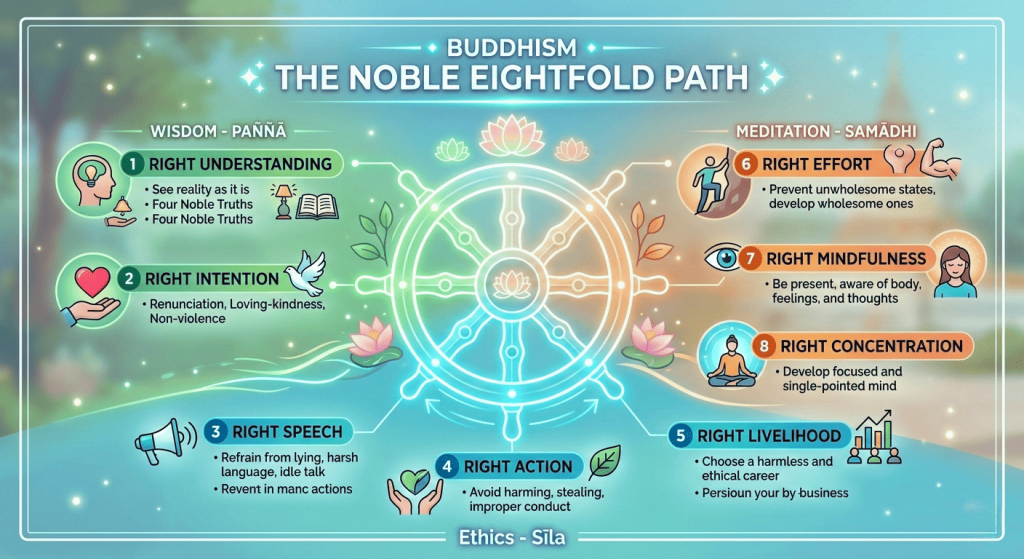
The fourth noble truth introduces a practical method for ending suffering. This method is called the Noble Eightfold Path.
The Eightfold Path is not a set of strict rules. Instead, it is a guide for cultivating wisdom, ethical behavior, and mental discipline.
The eight elements of the path are:
- Right Understanding – Seeing reality clearly and understanding the Four Noble Truths.
- Right Intention – Developing thoughts of compassion and non-attachment.
- Right Speech – Communicating truthfully and kindly.
- Right Action – Acting in ways that promote harmony and avoid harm.
- Right Livelihood – Choosing work that does not harm others.
- Right Effort – Maintaining positive mental states.
- Right Mindfulness – Cultivating awareness of thoughts, emotions, and actions.
- Right Concentration – Developing deep focus through meditation.
By following this path, individuals gradually train the mind and reduce the influence of craving and ignorance.
This disciplined approach helps people move toward spiritual awakening and greater inner freedom.
How the Four Noble Truths Support Spiritual Awakening
Spiritual awakening often begins when individuals start questioning the patterns that shape their lives. The Four Noble Truths provide a clear framework for this exploration.
First, they encourage self-awareness. By recognizing suffering and its causes, individuals begin observing their thoughts and emotional reactions more carefully.
Second, the teachings promote detachment from ego-driven desires. When people realize that constant craving leads to dissatisfaction, they naturally begin letting go of unhealthy attachments.
Third, the Four Noble Truths encourage mindful living. Practices such as meditation, ethical behavior, and compassion gradually transform the mind.
Over time, these practices lead to greater clarity, emotional stability, and inner peace. Many spiritual seekers describe this transformation as awakening—a shift in perception that reveals a deeper understanding of reality.
Practical Ways to Apply the Four Noble Truths in Daily Life
Although the Four Noble Truths are ancient teachings, they can easily be integrated into modern lifestyles. Small daily practices can bring their wisdom into everyday experiences.
Practicing Mindfulness
Mindfulness involves paying attention to the present moment without judgment. This practice helps people become aware of thoughts, emotions, and reactions.
Even simple activities like mindful breathing or conscious walking can strengthen awareness and reduce stress.
Observing Desires and Attachments
Instead of immediately reacting to cravings, individuals can pause and observe them. This awareness often reduces the intensity of those desires and creates emotional balance.
Developing Compassion
Compassion toward others—and toward oneself—is an essential part of spiritual growth. Acts of kindness help reduce ego-centered thinking and promote connection.
Meditation Practice
Meditation is one of the most powerful tools for spiritual awakening. Regular meditation trains the mind to remain calm and focused, allowing deeper insight into thoughts and emotions.
Through consistent practice, individuals gradually align their lives with the wisdom of the Four Noble Truths.
Why the Four Noble Truths Are Relevant in Modern Life
In today’s fast-paced world, many people experience constant stress, distraction, and dissatisfaction. Social media, consumer culture, and high expectations can intensify feelings of comparison and anxiety.
The Four Noble Truths offer a timeless solution to these challenges. They remind us that happiness does not come from chasing endless desires but from understanding the nature of the mind.
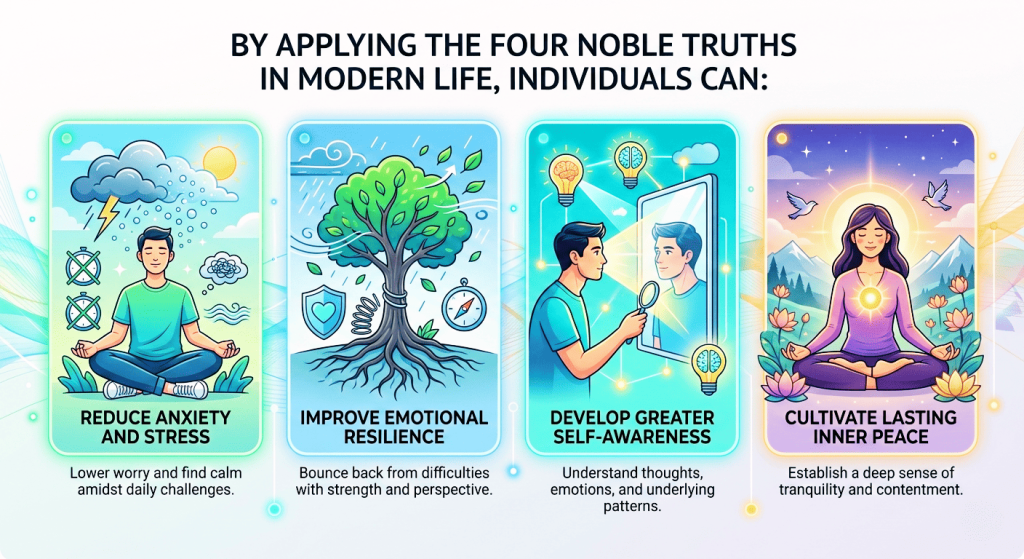
By applying these teachings, individuals can:
- Reduce anxiety and stress
- Improve emotional resilience
- Develop greater self-awareness
- Cultivate lasting inner peace
For many people in the modern world, this wisdom provides a path toward genuine spiritual awakening.
Conclusion
Understanding what are the Four Noble Truths of Buddhism and how do they support spiritual awakening reveals a powerful framework for personal transformation.
Rather than avoiding life’s difficulties, these teachings encourage us to examine them carefully. By recognizing suffering, understanding its causes, and following a path of mindful living, individuals can gradually free themselves from cycles of dissatisfaction.
The Four Noble Truths show that spiritual awakening is not reserved for monks or mystics. It is a journey that anyone can begin through awareness, compassion, and conscious living.
If you are seeking deeper peace and clarity, exploring these teachings may be one of the most meaningful steps on your spiritual path.