
Mindfulness Meditation for Spiritual Awakening: A Beginner-Friendly Step-by-Step Guide to Inner Transformation – 2026
In a world of constant notifications, pressure, and mental overload, many people feel something deeper is missing. Not success. Not productivity. But connection — to themselves, to others, and to something greater.
That longing often leads to one powerful practice: mindfulness meditation for spiritual awakening.
This is not about escaping reality. It’s about seeing it clearly. It’s not about becoming someone new. It’s about remembering who you truly are beneath stress, ego, and conditioning.
Let’s begin.
What Is Mindfulness Meditation for Spiritual Awakening?
Understanding Mindfulness Meditation
Mindfulness meditation is the practice of bringing full, non-judgmental awareness to the present moment.
You observe:
- Your breath
- Your thoughts
- Your emotions
- Physical sensations
Without trying to control them.
Modern mindfulness in the West was significantly influenced by Jon Kabat-Zinn, who developed Mindfulness-Based Stress Reduction (MBSR). His work helped translate ancient contemplative practices into a secular, research-backed framework.
At its core, mindfulness meditation teaches one simple but transformative skill:
Notice what is happening — without getting lost in it.
That skill becomes the foundation of spiritual awakening.
What Is Spiritual Awakening?
Spiritual awakening doesn’t mean floating above reality or having mystical visions (though some may experience profound insights).
More often, it means:
- Becoming deeply aware of your thoughts and patterns
- Recognizing the ego’s influence
- Feeling connected rather than separate
- Experiencing inner peace that isn’t dependent on circumstances
Authors like Eckhart Tolle in The Power of Now describe awakening as shifting from identification with thought to awareness itself.
Mindfulness meditation is the doorway to that shift.
How Mindfulness Meditation for Spiritual Awakening Works
Let’s explore both the scientific and spiritual mechanisms.
The Science: What Happens in the Brain

Research on mindfulness shows measurable neurological changes:
- Reduced activity in the amygdala (stress center)
- Increased thickness in the prefrontal cortex (decision-making and awareness)
- Improved emotional regulation
- Decreased rumination
In simple terms: you become less reactive and more aware.
When reactivity decreases, clarity increases.
And clarity is the soil where spiritual awakening grows.
The Spiritual Perspective: What Shifts Internally
As you practice mindfulness meditation for spiritual awakening consistently, subtle but profound shifts begin:
- You notice thoughts instead of becoming them.
- You pause before reacting.
- You feel less controlled by fear or ego.
- You experience moments of deep presence.
These moments may feel small at first. But over time, they reshape your identity.
Instead of “I am my thoughts,” the realization becomes:
“I am the awareness observing my thoughts.”
That recognition is awakening.
Step-by-Step Guide to Mindfulness Meditation for Spiritual Awakening
This practice does not require special equipment, religious belief, or extreme discipline.
Just consistency.
Step 1 – Create a Simple, Quiet Space
You don’t need a meditation room. A quiet corner works.
- Silence your phone
- Sit comfortably (chair or floor)
- Keep your spine upright but relaxed
Set a gentle intention:
“I am here to observe.”
No pressure. No expectations.
Step 2 – Focus on Your Breath

Close your eyes.
Bring your attention to your breathing.
Notice:
- The air entering your nose
- The rise and fall of your chest
- The pause between breaths
Do not control the breath. Simply observe.
If your mind wanders (it will), gently return to the breath.
This returning is the practice.
Step 3 – Observe Thoughts Without Attachment
At some point, you’ll notice thoughts like:
- “This is boring.”
- “Am I doing this right?”
- “What’s for dinner?”
Instead of fighting them, silently label them:
- “Thinking.”
- “Planning.”
- “Judging.”
Then return to the breath.
This is where mindfulness meditation for spiritual awakening becomes powerful.
You realize:
You are not your thoughts. You are the awareness behind them.
Step 4 – Practice Daily Consistency
Start with:
- 5–10 minutes per day
After two weeks, increase to:
- 15–20 minutes
Consistency matters more than duration.
Spiritual awakening is not a single event. It is a gradual unveiling.
Common Challenges (And How to Overcome Them)
Let’s address what most beginners experience.
“My Mind Won’t Stop Racing”
Good.
That means you’re finally noticing it.
The goal is not to stop thoughts. The goal is to observe them.
Imagine sitting beside a highway instead of standing in traffic.
“I Don’t Feel Spiritually Awakened”
Awakening is subtle.
It often looks like:
- Slightly less irritation
- Slightly more patience
- Slightly more awareness
These small changes accumulate.
Over months, they become profound.
Emotional Releases
As you become more present, suppressed emotions may surface.
Sadness. Anger. Fear.
This is not regression. It is healing.
If emotions feel overwhelming:
- Open your eyes
- Take deeper breaths
- Place your hand on your chest
Ground yourself gently.
Signs Mindfulness Meditation for Spiritual Awakening Is Working
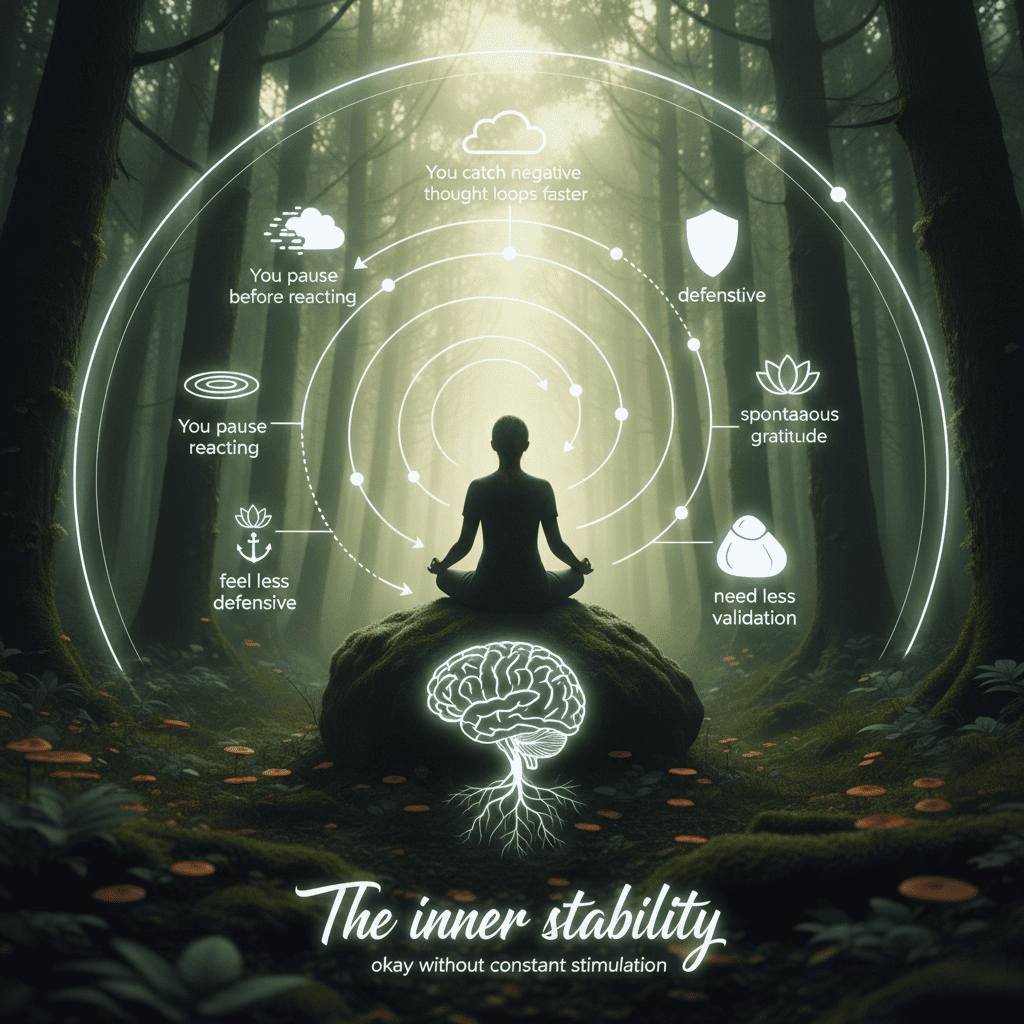
Progress doesn’t always feel dramatic.
Here are realistic indicators:
- You pause before reacting
- You catch negative thought loops faster
- You feel less defensive
- You experience spontaneous gratitude
- You need less external validation
Perhaps the most powerful sign:
You feel okay without constant stimulation.
That is inner stability.
How Long Does Spiritual Awakening Take?
There is no fixed timeline.
However:
- Immediate benefits: calmness, clarity
- 2–4 weeks: improved emotional regulation
- 8 weeks: measurable brain changes (as seen in structured programs)
- Months to years: deeper identity shifts
Awakening unfolds in layers.
Trying to rush it delays it.
Practicing patiently accelerates it.
Integrating Mindfulness Into Daily Life
Formal meditation is essential.
But daily integration transforms everything.
Here’s how to apply mindfulness meditation for spiritual awakening beyond your cushion:
Mindful Walking
While walking:
- Feel your feet touching the ground
- Notice the air on your skin
- Observe surroundings without labeling
Mindful Eating
Before eating:
- Pause
- Notice the smell
- Taste slowly
- Avoid scrolling
Presence transforms routine into sacred.
Mindful Communication
When someone speaks:
- Listen fully
- Avoid planning your reply
- Notice emotional reactions
This reduces conflict and deepens connection.
Digital Mindfulness

Before checking your phone, ask:
“Why am I reaching for this?”
Small awareness interrupts unconscious habits.
The Deeper Transformation
With sustained mindfulness meditation for spiritual awakening, a deeper realization emerges:
You are not the constant stream of thoughts.
You are the space in which thoughts appear.
That realization reduces fear.
It reduces ego.
It increases compassion.
You begin to see others not as threats or competitors, but as fellow human beings navigating their own inner storms.
This shift is quiet.
But it changes everything.
Final Thoughts: Your Awakening Begins Now
You do not need:
- A retreat
- A guru
- A perfect life
You need presence.
Five minutes today.
Ten minutes tomorrow.
Consistency over intensity.
Mindfulness meditation for spiritual awakening is not about becoming someone extraordinary.
It is about uncovering what has always been there — awareness, peace, clarity.
Start today.
Sit.
Breathe.
Observe.
Return.
Your journey inward is the most important one you will ever take.
FAQs
What is mindfulness meditation for spiritual awakening?
How does mindfulness meditation lead to spiritual awakening?
How long does mindfulness meditation for spiritual awakening take to work?
Can beginners practice mindfulness meditation for spiritual awakening?
What are the signs that mindfulness meditation for spiritual awakening is working?
– Less emotional reactivity
– More patience in stressful situations
– Reduced overthinking
– Greater self-awareness
– A deeper sense of calm
Spiritual awakening does not always feel dramatic. It often feels like quiet stability.
Is mindfulness meditation for spiritual awakening religious?
Why does my mind feel busier when I start mindfulness meditation?
Can mindfulness meditation trigger emotional releases during spiritual awakening?
How often should I practice mindfulness meditation for spiritual awakening?
Can mindfulness meditation completely change my life?
The change is quiet — but powerful.